Header
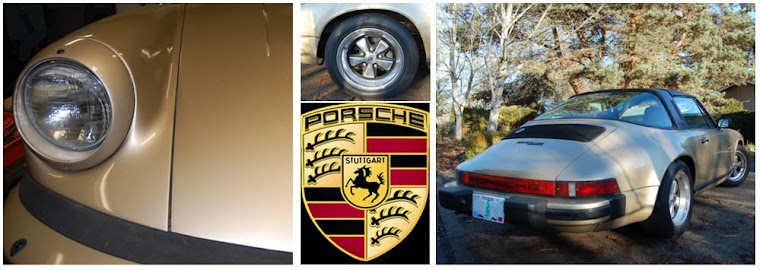
1983 Porsche 911 SC Targa
Wednesday, August 28, 2013
Wheel Alignment and Weight Distribution
I can’t say enough good things about Rothsport Racing, an automotive shop in Tualatin, Oregon specializing in Porsche. I took the car in to get an alignment after switching to stiffer torsion bars. The shop was great. There were six car up on lifts, a machine shop, and several 911s, some set up for full racing. I was a little apprehensive bringing an electric Porsche to a Porsche racing shop, because I wasn’t sure how the car would be received. Jeff Gamroth, the proprietor, introduced himself, and after a quick show and tell, we took the car for a quick spin down the street. He liked the torque, but said the lack of engine noise was strange. We then pulled the car around into the shop bay, and five mechanics immediately flocked to the car. The silent entrance certainly got everyone’s attention. “Was that you guys? We heard a strange sound going down the street.” Everyone seemed OK with the electric modifications, or at least kept their horror in check. There were lots of questions about the batteries, range, safety advice to avoid electrocution while working on the car, and for the first time someone noticed my tachometer sensor mounted on the electric motor tail shaft. One of the guys joked, “At least you didn’t bolt on an LS2,” a jab at the practice of installing a Chevy Corvette V8 motor in a 911.
The alignment did wonders for the handling of the car. The steering is lighter and more precise. As a bonus, they also put the car on a scale. My conversion tips the scale at 3158 pounds (1432 kg), and is 408 pounds (185 kg) over stock. The front is heavier by 231 lbs and the back 177 lbs, shifting the front/back weight distribution from 38/62 to 40/60.


Friday, July 26, 2013
1000 Miles, 1000 Amps
I recently logged my first 1,000 EV miles. It was time to bump the Soliton 1 controller to the maximum setting of (cue the sinister movie sound clip) – 1,000 amps. There are a couple reasons to begin with a low current and ramp up to greater performance over time. While testing out the new EV system, a low current setting will minimize damage, if there is a problem. Another reason is I’m using a motor with brushes.
When a DC motor is new, the brushes do not make full contact with the commutator. Small imperfections in the contour radius at the brush and commutator interface increase the electrical impendence of the motor. If you try to pass a lot of current through new brushes, the motor is at risk of arcing and overheating. On the bench, I ran the motor for 30 hours at 12 volts. Then, when first installed into the car, the gradual increase in motor current allowed the brushes to properly seat as the high points on the brush get worn away.
With the 1000 amp limit, the difference in performance is significant and amazing. The extra 40 kilowatts of power (50 HP), relative to 600 amps, makes the car fly. The stock 3.0 liter internal combustion engine (ICE) output was rated 127 kW (170 HP). As an electric conversion, I recently logged a run on my commute to work with a current draw of 890 amps producing 120 kW of power (160 HP).
When a DC motor is new, the brushes do not make full contact with the commutator. Small imperfections in the contour radius at the brush and commutator interface increase the electrical impendence of the motor. If you try to pass a lot of current through new brushes, the motor is at risk of arcing and overheating. On the bench, I ran the motor for 30 hours at 12 volts. Then, when first installed into the car, the gradual increase in motor current allowed the brushes to properly seat as the high points on the brush get worn away.
With the 1000 amp limit, the difference in performance is significant and amazing. The extra 40 kilowatts of power (50 HP), relative to 600 amps, makes the car fly. The stock 3.0 liter internal combustion engine (ICE) output was rated 127 kW (170 HP). As an electric conversion, I recently logged a run on my commute to work with a current draw of 890 amps producing 120 kW of power (160 HP).


The logged run did 0 to 60 MPH in 9 seconds. I started in 2nd gear and at 5.7 seconds I shifted to 3rd. The 0 to 40 time was 4 seconds. If I open up my motor RPM limit to 5,500 I can reach 60 MPH in second gear and avoid the 2 second penalty of shifting. 2 seconds is a long shift, but I’m still getting used to this gearbox and after 97,000 ICE miles, the synchro-mesh is not in best form . The car seems to be on par with the stock performance, especially given that with the electric motor, peak torque is available between 0 and 5,000 rpm. I need to find an open bit of road with no traffic and see what happens when I push the full 1,000 amps.
Monday, July 22, 2013
Celebrate Hillsboro and Another Video
I had the car on display at a local event called Celebrate Hillsboro – a city festival with music, kids activities, sports, bicycle rides, and a farmers’ market. My car was positioned in the intersection right in the middle of the event. The car generated a lot of positive attention.

A few people expressed disappointment in my choice of donor. Some were misinformed on the performance capability of electric drive and others were dismayed that I messed with a classic. But the response was overwhelmingly positive. I even met a few people that are currently converting their own vehicles. By far the most common questions I get are range, cost and battery life (100 miles, a lot, and 3000 cycles).
I’ve received a lot of requests for another video. I’m pleased that the controller in quiet mode no longer generates that obnoxious 8 kHz switching buzz.
Monday, July 15, 2013
EV Celebration Day, part 2
 |
| Photograph by Patrick Connor @ oeva.org |
We filled Portland’s Pioneer Courthouse Square with electric cars – both commercial vehicles and electric conversions. A large crowd turned out and the weather was perfect. Overall it was a really good event. I was impressed that the general public’s awareness of electric vehicles has gone up over the last 10 years.
 |
| From left to right - Toyota Corolla, Porsche 911, Nissan Leaf, Tesla Model S, truck conversion. Photograph by Bill Bates. |
 |
| Pride in ownership. |
 | ||||||
| There was a steady stream of visitors all day long. Photograph by Bill Bates. |
 |
| Discussing the finer points of AC vs DC motors, and the price of lithium. |
 | ||||||
| Oregon State University solar race car. |
John Wayland, electric drag racing pioneer and owner of the fastest street legal electric drag car in the world, introduced himself and shared some wild adventures of when he owned a Porsche 911 SC. He says that the Zombie’s times are going to drop into the 9 second range for the ¼ mile.
 | ||||
| White Zombie is a 1972 Datsun that has been modified to go fast. Photograph by Patrick Connor @ oeva.org |
 |
| Twin 9 inch motors and low mass are part of the White Zombie go fast equation. Photograph by Patrick Connor @ oeva.org |
 |
| This electric VW bus conversion is beautiful. Photograph by Patrick Connor @ oeva.org |
 |
| I love that the motor mount and motor face are exposed. Truly a work of art. Photograph by Patrick Connor @ oeva.org |
 |
| Electric bug and electric bicycle. Photograph by Patrick Connor @ oeva.org |
 |
| Everyone loves the Tesla Model S. Photograph by Patrick Connor @ oeva.org |
 |
| Some electric vehicles with only two wheels. Photograph by Patrick Connor @ oeva.org |
 |
| The TH!NK city (red and black) are cute cars. Too bad they are not currently in production. Photograph by Patrick Connor @ oeva.org |
Subscribe to:
Posts (Atom)